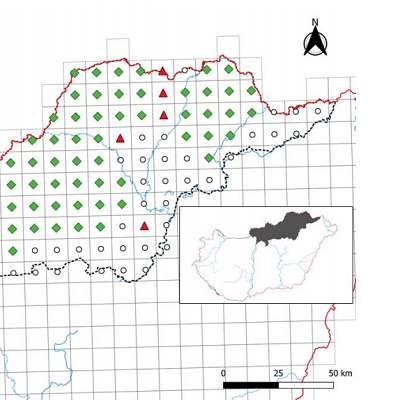
The range and population size of the grey wolf has increased in recent decades in Europe, and the species has also reappeared in Hungary. According to hunters, the increasing presence of wolves in the North Hungarian Mountains has a significant impact on the deer population. We investigated how stressed the red deer are by the wolves and whether their condition is worse in wolf areas than in sites where the predator is not present. The questionnaire among the hunters revealed the increase in the range of the wolves. The faecal samples of the deer collected from the ground in the area where wolves were not present showed lower stress levels than in other areas. The body fat reserves of the deer individuals were equal in wolf areas and wolf-free sites. Our results do not support a very intense recent impact of the wolf population on the body condition and stress level of red deer in Hungary.
Population density in 2021: 1.8 ind/km2 ... If the deer harvest density is compared to the German (0.23 deer/km2), Austrian (0.68 deer/km2), Slovenian (0.44 deer/km2), Polish (0.4 deer/km2), or the Czechian (0.42 deer/km2) data, it seems very high, while in Slovakia, for example, a similar value was found (1.01 deer/km2).
... In the last 20 years, three surveys have been carried out, asking all local game managers in the region whether grey wolves occur in their area. The result of the first such survey was summarised in 2006; then, the study was repeated in 2014, and finally, in 2021.
Továbbá:
Borsodban már a farkasok ellen védekezésre készülnek